
Long-term consequences of post-traumatic brain injury
Group Alice Jacquens et Vincent Degos
Head injury is a public health problem, and is the most frequent cause of permanent disability in people under 40. Recently, several teams have highlighted the existence of tertiary lesions occurring up to several years after the trauma, during which a microglial neuroinflammatory phenomenon persists and becomes more pronounced, leading to post-concussion syndrome. In children, head trauma presents a number of particularities linked to the immaturity of the central nervous system. In addition, it can have a lifelong impact on these patients, who may develop cognitive and developmental disorders as they grow older. However, there is currently no treatment available to control the onset or evolution of these lesions.
We are studying the long-term effects of pediatric traumatic brain injury (TBI) in a mouse model. TBI is induced in mice at postnatal day 7 (P7) by weight-drop trauma. This model has been studied in previous works and is the source of acute neuroinflammation with microglial and astrocytic activation, and later, at P45, white matter lesions with thinning of the corpus callosum in TBI mice was detected by immunohistochemistry and confirmed by MRI. In addition, adolescent mice with pediatric TBI showed persistent social interaction deficits and signs of anxiety and depressive behaviors. We have also shown the presence of chronic abnormal microglial and astrocyte reactivity at the impact site in adult TBI mice at P45, suggesting a glial memory.
Our current projects are to study the long-term and distant consequences of head trauma on the cerebellum, and to find therapeutic strategies to limit the consequences of acute and chronic neuroinflammation in adulthood.
Members:
Alice Jacquens (Senior Registrar), Vincent Degos (Research Associate), Stéphanie Sigaut (Research fellow), Hélène Cwerman-Thibaut (Engineer), Abderazak Sidi-Salah (Technician)
Recent publications:
Deleterious effect of sustained neuroinflammation in pediatric traumatic brain injury. Jacquens A, Csaba Z, Soleimanzad H, Bokobza C, Delmotte P-R, Userovici C, Boussemart P, Chhor V, Bouvier D, van de Looij Y, Faivre V, Diao S, Lemoine S, Blugeon C, Schwendimann L, Young-Ten P, Naffaa V, Laprevote O, Tanter M, Dournaud P, Van Steenwinckel J, Degos V, Gressens P. Brain Behav Immun 2024 Aug:120:99-116. doi: 10.1016/j.bbi.2024.04.029.
Long-Term Cerebellar Consequences of Post-traumatic Brain Injury Assessed by MRI With Diffusion Tensor Imaging. Delmotte PR, Perret Liaudet B, Torkomian G, Unrung J, Cassereau D, Debarle C, Mathon B, Perlbarg V, Puybasset L, Degos V, Jacquens A. Neurosurgery. 2024 Nov 18. doi: 10.1227/neu.0000000000003274.
MRI volumetry and diffusion tensor imaging for diagnosis and follow-up of late post-traumatic injuries. Jacquens A, Delmotte PR, Gourbeix C, Farny N, Perret-Liaudet B, Hijazi D, Batisti V, Torkomian G, Cassereau D, Debarle C, Shotar E, Gellman C, Mathon B, Bayen E, Galanaud D, Perlbarg V, Puybasset L, Degos V. Ann Phys Rehabil Med. 2024 Mar; 67(2):101783. doi: 10.1016/j.rehab.2023.101783.
Neuro-Inflammation Modulation and Post-Traumatic Brain Injury Lesions: From Bench to Bed-Side. Jacquens A, Needham EJ, Zanier ER, Degos V, Gressens P, Menon D. Int J Mol Sci. 2022 Sep 23;23(19):11193. doi: 10.3390/ijms231911193.
Contacts
Alice Jacquens
NeuroDiderot, Inserm U1141
Hôpital Robert Debré
48 boulevard Sérurier
75019 Paris
alice.jacquens@inserm.fr
Vincent Degos
NeuroDiderot, Inserm U1141
Hôpital Robert Debré
48 boulevard Sérurier
75019 Paris
vincent.degos@inserm.fr
À lire aussi
Conference Postponed Alexandra Benchoua from I-Stem : Human pluripotent stem cell models for high-throughput screening of therapeutic molecules and precision medicine in neurodevelopmental disorders.
Meeting Room 6th floor Bingen Building and Visio https://u-paris.zoom.us/j/84730677369?pwd=AFdhdI6alNWLbXub7sM1DJ33yUIOYN.1 - Summary séminaire A-Benchoua _27-nov-2025 english
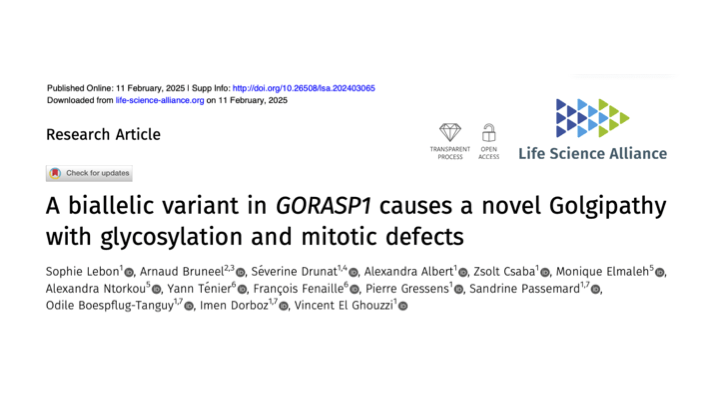
New Golgipathy identified in NeuroDev team
The NeuroDev team publishes an article in Life Science Alliance [1] identifying the first human pathogenic variant of GORASP1, the gene encoding the Golgi stacking protein GRASP65, and demonstrating its consequences on glycosylation and mitotic progression. [1] S....

Job opportunity within The Integrative Genomics in Neurodevelopment group
The Integrative Genomics in Neurodevelopment group is seeking a highly motivated post-doctoral researcher. Check out the opportunity here: Post-doc researcher position in Computational Biology
Sleep2Develop research program
The Sleep2Develop program investigates the role of sleep as a promotor of neurodevelopment and identifies the sleep determinants of childhood development. This is rephrased as Sleep(to)Develop? or Sleep(to)Develop! Our sleep research combines clinical and...